NOTE· 2026-02-19· 6 min
Claude Sonnet vs. Opus: Which Model for Which Task
A practical comparison of Sonnet and Opus inside a five-tier lineup. When Sonnet is enough, when Opus earns its price, and where the new Fable tier fits.
Updated 11 June 2026 for Opus 4.8 and the new Fable 5 tier.
The Claude model family grows fast. With Sonnet 4.6, Anthropic narrowed the old split (Sonnet for daily work, Opus for demanding tasks): it now handles coding and tool work that used to need Opus. Since then the lineup has expanded further: Opus moved to 4.8, and a new tier, Fable 5, launched above Opus on 9 June 2026. Time for a status check from practice.
I work with all three models daily. The short version of my experience: the most expensive model is rarely the right choice, and the newest isn't automatically the best across the board.
The three models at a glance
The lineup now runs five tiers: Haiku, Sonnet, Opus, Fable, and Mythos. For most marketing and content work, the Sonnet-vs-Opus question is still where the decision actually happens. More on Fable below.
Claude Sonnet 4.5 is the balanced model of the last generation: fast, precise for structured tasks, strong enough for most content and workflow work. If you already have Sonnet 4.5 in running workflows, you have a stable base.
Claude Sonnet 4.6 is the current model in the middle. Early experience shows clearly better performance on coding tasks: it infers what you mean without requirements spelled out in excessive detail.
Claude Opus 4.8 is the power model: slower, more expensive, but with deeper reasoning. It fixed the comment-verbosity and flaky tool-calling issues from 4.7, and now defaults to high effort. On long contexts, strategic tradeoffs, and tasks that need several thinking steps, Opus 4.8 keeps the overview better than the Sonnet models. See my full Opus 4.8 review for detail on what changed. Pricing is unchanged: $5/M input, $25/M output ($10 and $50 for fast mode).
What Sonnet 4.6 does concretely better
My first larger project with Sonnet 4.6 was a practical test: a browser-based image converter with compression for my own site. Fully client-side, no server backend.
What stood out: Sonnet 4.6 built the tool quickly and cleanly, and then extended it without me having to spell out every step. I described the goal, the model made the technical decisions (file format handling, compression logic, UI structure) sensibly.
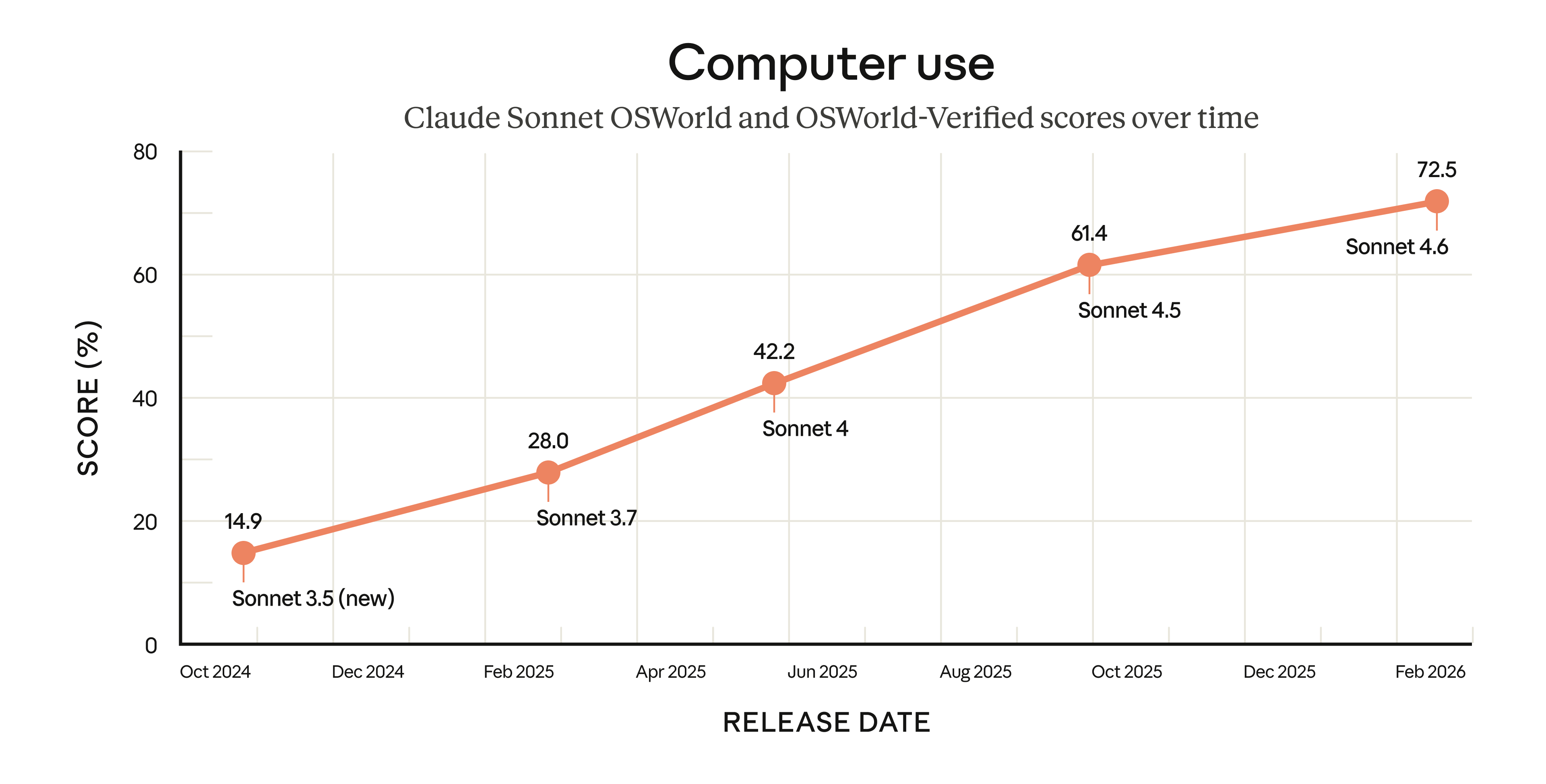
Claude Sonnet over time. Model 4.6 reaches a noticeably higher score than 4.5. Source: https://www.anthropic.com/news/claude-sonnet-4-6
That's different behavior from Sonnet 4.5. With that one I had to provide a lot more context on coding tasks to get comparable results.
For coding tasks this means: if you build small tools, scripts, or browser-side applications (especially in a marketing context where you don't want to set up a full development environment), Sonnet 4.6 is a real step forward. Less prompt engineering, still usable results.
That also matters for Vibe Coding: marketers who want to build their own small tools without being developers will benefit from Sonnet 4.6.
Do you still need Sonnet 4.5?
Since Sonnet 4.5 and 4.6 cost the same, the price argument falls away entirely. The honest answer: if you have Sonnet 4.5 in stable, tested workflows (n8n, API calls in series, batch processing), you don't need to switch right away. The behavior is known, the integration runs.
If you're starting fresh or building a new workflow, go straight with Sonnet 4.6. Same price, better performance, no rational reason to pick the older version.
Where Opus 4.8 makes the difference
Complex strategy tasks
When you develop a marketing concept or have to weigh conflicting requirements: Opus 4.8 keeps more context in view at once and catches dependencies the Sonnet models sometimes simplify.
Long context with many variables
On tasks where you pass very long documents and the answer depends on details in different places, Opus 4.8 is more reliable. The model loses the thread less often.
Complex prompt development
When I develop prompts that then run in automations (prompts that need to work across many different inputs), I use Opus 4.8. It thinks the edge cases through better. It's also a bit better at asking clarifying questions before running, which reduces wasted iterations.
Creative work with strategic ambition
For articles where originality and angle count, not just correct information, Opus 4.8 delivers more differentiated results. The difference isn't dramatic, but it's noticeable.
Where Fable 5 fits (and usually doesn't)
On 9 June 2026, Anthropic launched Claude Fable 5, the first model in a new Mythos class, sitting above Opus in the lineup. Claude Mythos 5 is the same model without the public guardrails, restricted to approved organizations, so the highest tier most people can actually use is Fable. The pricing reflects the new position: $10/M input, $50/M output, exactly double Opus 4.8's standard rate.
The use cases where it genuinely earns that cost: multi-hour autonomous agent runs (it can sustain a complex task for up to 12 hours), large codebase migrations at the scale of tens of millions of lines, million-token context jobs where you need the whole thing active at once, and one-shot builds of complex interactive systems. According to Anthropic's launch announcement, Stripe ran a 50-million-line Ruby migration in about a day with it.
For daily content work, browser tools, small automation, or any task where you're reviewing and redirecting after each step anyway, Opus 4.8 is already more than enough. The doubling in cost doesn't change what you produce on those tasks. Simon Willison spent $110 testing it in a single day, $99 of it on one project.
My practical answer: stay on Opus 4.8 for everyday work. If you have a specific task that fits the Fable use case, spin it up for that job. Don't let it become the default. For the full breakdown, see my Fable 5 review.
My current workflow
The principle still holds: no single model for everything. Sonnet 4.6 joins the stack like this:
I still use Sonnet 4.5 for:
- Automated steps in n8n (API calls in series)
- Structuring research results
- Social media drafts and email copy
- Quick summaries and classifications
Sonnet 4.6 I use for:
- Coding tasks and tool development (without detailed specifications)
- Vibe coding: quick browser-based tools
- First draft of articles on more complex topics
- Tasks where I want less prompt overhead
Opus 4.8 I reserve for:
- Strategy discussions and concept development
- Complex prompt development for automations
- Code review and workflow architecture
- Anything where I need the full context of a long conversation
What this means for your model selection
The question isn't only "Sonnet or Opus?" anymore, but which task needs which model and which tier is worth paying for.
If you're new to Claude, start with Sonnet 4.6: it covers more tasks than 4.5 and needs less prompt engineering.
If you want to do coding tasks with the least effort (small tools, scripts, browser apps), Sonnet 4.6 has been the fastest and most reliable option for me on exactly those tasks.
If you've been using Opus for coding because Sonnet 4.5 wasn't enough: Sonnet 4.6 is worth a test. It's faster and delivers comparable results at a fraction of the Opus price, which means you only reach for Opus when the task genuinely needs it.
For context management and routing across all five tiers, my context engineering post and the Claude Code skills field report cover the practical habits that keep costs reasonable.
FAQ
- Should I use Claude Sonnet or Opus?
- Match the model to the task. Sonnet 4.6 handles most content and coding work faster and cheaper, with less prompt detail. Reserve Opus 4.8 for strategy, complex prompt development, code review, and long-context tasks with many variables, where its deeper reasoning earns the price.
- Is Sonnet 4.6 better than Sonnet 4.5?
- For new work, yes: same price, better performance, and less prompt engineering, especially on coding and tool building. But if you have Sonnet 4.5 in stable, tested workflows like n8n or batch API calls, there's no urgency to switch, since the behavior is known.
- When is Opus 4.8 worth the higher cost?
- For complex strategy and concept work, weighing conflicting requirements, developing prompts that must run across many inputs in automations, code review and workflow architecture, and long documents where the answer depends on scattered details. It also holds complex multi-part tasks together slightly better than Opus 4.7 did.
- Do I need Claude Fable 5 instead of Opus?
- For most daily work, no. Fable 5 is built for multi-hour autonomous agent runs, migrations of tens of millions of lines of code, million-token context jobs, and one-shot complex builds. For content workflows, browser tools, small automation, and everyday coding, Opus 4.8 on high effort is already more than enough. Fable 5 costs double Opus and the extra capability rarely matters for typical marketing and tool work.